
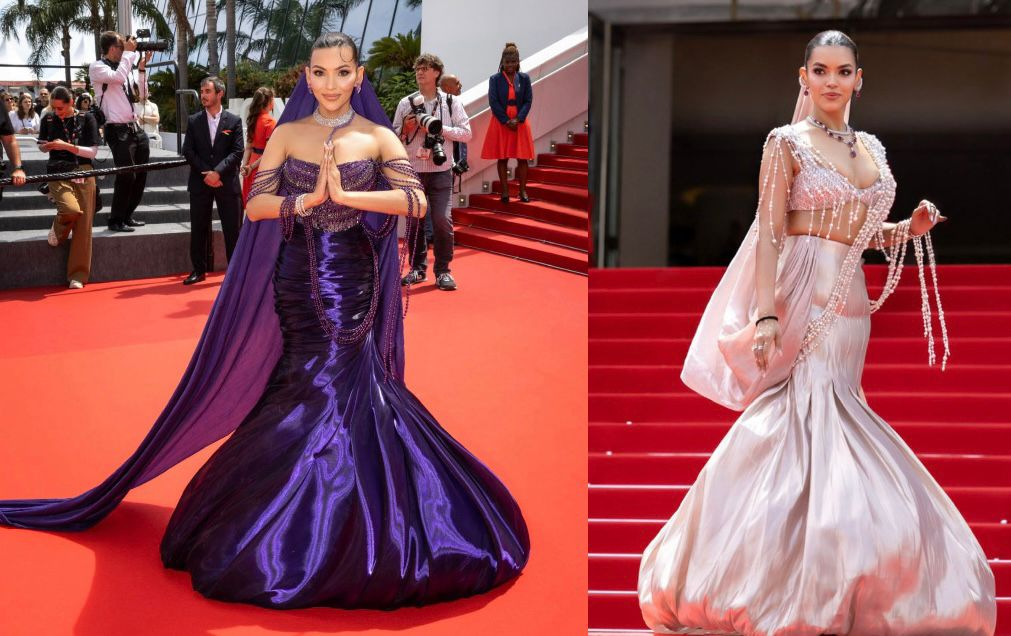
From Dibrugarh to the Croisette, mother‑and‑daughter duo Urmimala and Snigdha Baruah made more than a red‑carpet entrance at Cannes Film Festival 2026 — they staged a cultural reclamation. Walking the world’s most photographed staircase in custom couture by Manish Malhotra, they turned the traditional Assamese ghungat into a soaring symbol of identity, dignity and belonging.
The Barua(h)s’ Cannes return felt like an answer to a long, quiet conversation about the Northeast’s place in India’s cultural imagination. Where stereotypes and sidelining have often rendered the region invisible on national stages, Urmimala and Snigdha arrived wrapped in heritage and intent: to be seen on their own terms.
Manish Malhotra, known for marrying Indian craft with red‑carpet glamour, collaborated closely with the pair to translate Assamese motifs into eveningwear that reads both intimate and cinematic. Snigdha floated in blush silk, the ghungat reimagined not as concealment but as a ceremonial frame. Hand‑strung pearls traced the veil’s edge like whispered lineage; a 120‑carat ruby and diamond necklace — three months in the making — sat like a modern talisman at her throat. The look married bridal tradition and contemporary language, signaling that rootedness need not be retrograde.
Urmimala chose midnight violet, a choice that read as regal defiance rather than demure tradition. Crystalline structures fractured her silhouette into architectural planes: the veil became armor, light catching at facets to create motion and meaning. Complementary Brazilian amethysts — each stone surpassing 20 carats after painstaking setting — completed an ensemble that felt both ancestral and audacious.
What resonated beyond jewels and silk was the deliberate elevation of the ghungat. In Assam and other Northeastern cultures, the veil carries complex social histories of respect, privacy and feminine dignity. At Cannes, it was carried into global conversation as more than textile; it became a headline act for Northeastern presence within Indian identity. The Barua(h)s’ choice was also generational: a mother’s tradition, reinterpreted by a daughter who bridges local memory and world stages.
The UMB initiative — the pageant and mentoring platform founded by Urmimala and Snigdha — frames the duo’s Cannes appearances as part of a longer work. UMB nurtures regional talent and visibility, creating pathways for women from Assam and neighbouring states to tell their stories. The Cannes gowns, then, are both culmination and catalyst: couture as conversation starter, visibility as advocacy.
For Indian fashion, the moment was significant. If previous years introduced regional markers like Kolhapuri footwear into international narratives, 2026 put the ghungat front and centre. Malhotra’s craft, combined with the Barua(h)s’ insistence on rooted expression, posed a question to the global style circuit: how can it imagine Indian glamour without the Northeast? The answer — increasingly clear on the red carpet — is: it cannot.
This appearance also underscored a changing media geography. Stories that once sidestepped the Northeast’s contributions are now being written atop its aesthetics and politics. For Assam, a state often reduced to reductive headlines, this felt like reclamation: fashion used as diplomacy, heritage as speech.
At the base of the Croisette steps, cameras flashed and the usual currents of celebrity glamour swirled. But in those moments of light and shutter, the ghungat did its quieter work. It asked viewers to look twice: to recognise not just silk and jewels but lineage; not just spectacle but representation.
Urmimala and Snigdha Baruah did not come to Cannes merely to wear a label. They came to amplify a region, to insist on visibility, and to show — in silk, pearls and amethysts — that Assam’s daughters stand shoulder to shoulder with global icons. The gowns, the jewels and the message were inseparable: heritage walks in, eyes up, unapologetically present.
